Hybrid interfaces
Screens, chat and voice designed together, so people can move between clicking and asking without losing their place.
Services / 06
Research, information architecture, interface design and design systems for products people rely on at work: clinical reporting, security platforms, leasing, fleets and public services.

The challenge
AI can produce a hundred interface variations before lunch. None of them knows what a clinician needs at the end of a long shift, or what a failed payment should say. Product design is still a series of decisions about people, edge cases and trade-offs, and it now includes deciding what an assistant should do, say and hand back to a person.
What it is
Product and experience design decides what a product does, how it is organised and how every screen behaves. It covers research with the people who will use it, information architecture, interaction and interface design, prototyping, and the design system engineers build from. Our designers work next to our engineers, so what gets designed is what gets built, down to the empty states and error messages.
Interfaces for specialists and for the public, where clarity carries real consequences.
Dense tables, dashboards, filters and multi-step workflows for people who use the software all day.
Interfaces where terminology, sequence and attention matter, like the reporting workflow in Omnimedica.
A clear hierarchy for large volumes of information, like the complete platform design we created for Mind The Hack.
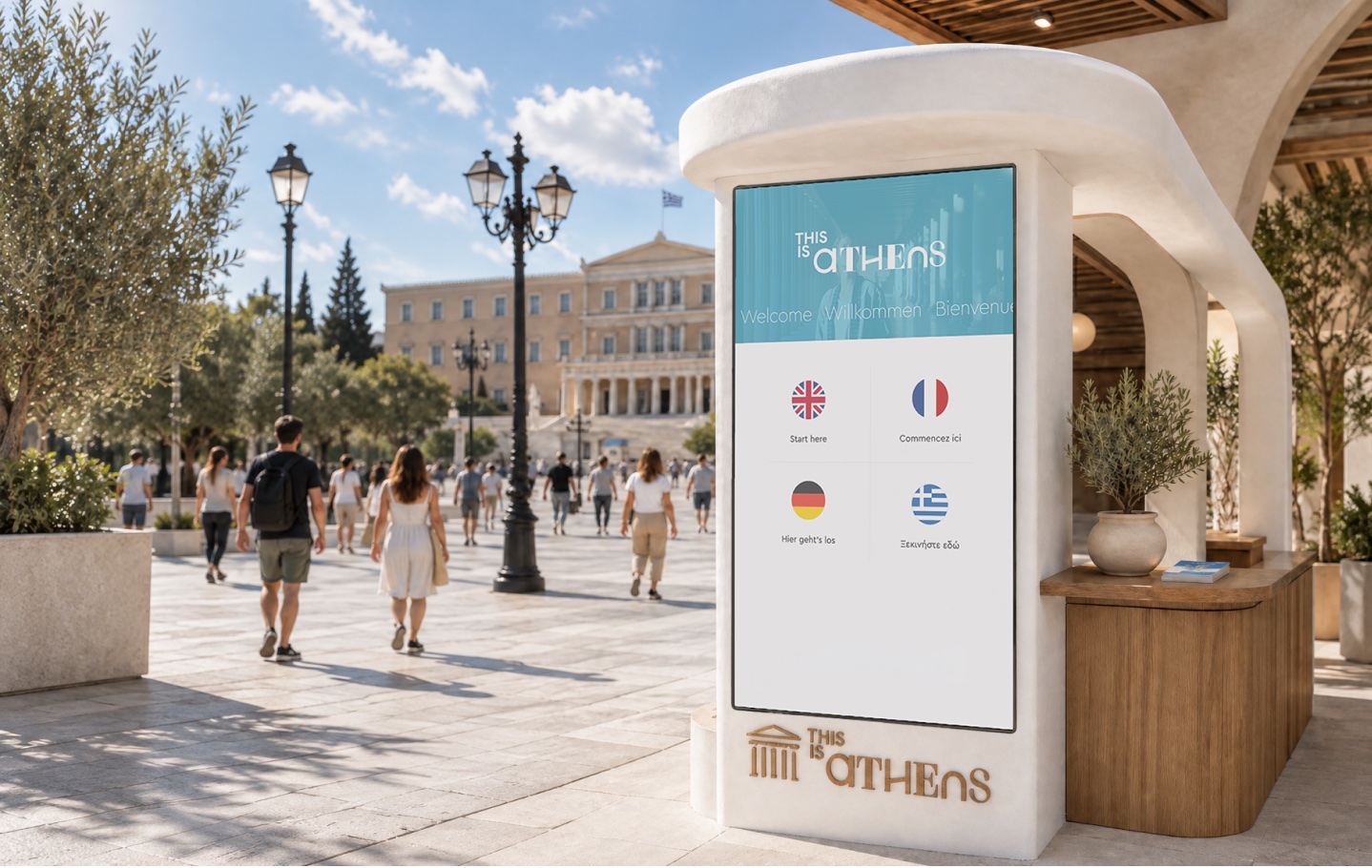
Interfaces that explain themselves to first-time users, like the This is Athens platform at airports and across the city.
Components, tokens and rules shared between design and code, so a product stays consistent as it grows.
Intelligence, built in
We believe the best products will be both: precise screens for work that needs them, and conversation for everything a person would rather just ask. We design the two as one experience.
Screens, chat and voice designed together, so people can move between clicking and asking without losing their place.
Clear previews, approvals and undo for work an agent does on someone’s behalf, so people stay in control of what is done in their name.
Sources, confidence and a visible route to a person, built into every AI-assisted moment of the product.
Where the interface carries the work.
How we work
Interviews, observation of the real workflow and a review of existing tools, so we design for the work itself rather than a description of it.
Information architecture, user flows and the rules for every state, agreed before visual design begins.
Interfaces designed in Figma and pen.dev, prototyped and tested with real users before engineering commits.
Designers stay through implementation and design QA, and the design system evolves with the product.
Scope
Questions
Yes. We start from how it is used today, keep what works, and roll out changes in steps so people are not forced to relearn everything at once.
Partly. Some work is faster by asking and some needs a precise screen. We design both and let people move between them.
Usually, yes: our designers and engineers work on the same projects. We also design products that other teams build, as we did for the Mind The Hack platform.
Figma and pen.dev for interface design and prototyping, and FlowNode, our own creative AI platform, for visual exploration.
Contrast, keyboard use, focus, readable type and clear states are part of the design system, and we review them during design QA.
More services
Customer portals, partner platforms, multi-tenant SaaS and the internal systems behind them.
Custom CRM, ERP and operations software: customers, orders, assets, fleets and reporting in one system.
Finding where AI pays, redesigning the work around people and agents, and scaling what works.
LLM fine-tuning, domain and speech models, evaluation, private deployment and AI inside real products.
Leasing platforms, booking engines, quoting, applications, payments and commerce.
Positioning, naming, identity and living brand systems that carry into products, websites and AI.
WebGL and Three.js websites, real-time 3D, product visualisation and 3D production.
DevSecOps, manual code audits, row-level security, multi-tenant governance and compliance by design.